Small dynamic mic for low frequency applications The Good
.jpg)
This mic kicks and snaps! With a little EQ, it could restart a heart on the right system. Also, it’s affordable and pretty discreet.
.jpg)
Sometimes it picks up too much of the bottom end and requires a gate to compensate for the low frequency resonance.
.jpg)
The D4’s small size makes it ideal for the stage. It can handle really loud instruments without a problem and is not limited to the kick. The best of a bari or tenor sax might be found through this mic, as well.

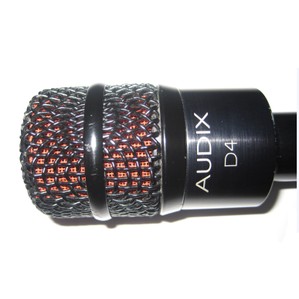
Audix D4 Dynamic Microphone
Small dynamic mic for low frequency applications
It may not be a well-known fact, but people dance to the kick drum. It’s the ultimate instigator. If girls aren’t shaking what their mamas gave ‘em, you need to take a cold, hard look at your kick drum production. And, assuming you have a half-decent kit, you should start with your microphone.
Luckily, Audix has made an idiot-proof line of instrument microphones for stage or studio. The D4 is part of that line, and is not exclusive to the kick drum. Virtually any instrument that dwells in the low-end or has lower harmonic extensions can benefit from this mic. This includes the sax, trombones, floor toms, djembe and other deep percussion instruments.
I gave the D4 its fair beatings on stage and in the studio. One of its shining qualities is that it performs consistently well in both environments. I usually run it through a gate and EQ, especially in the studio.
You might find, as I did, that the sub frequencies resonate with this mic. I thought it was the kick drum itself, but I didn’t hear the same noise when listening to the drum. This is good in certain regards. If you want a full-bodied kick, use the D4 without any dynamic processing and it will heavily occupy from about 30Hz up to the 300Hz range. If you want to get the snap and presence out of your D4, gate it and boost the 4kHz range. Be conservative with that boost, though. It can sound plastic, like tapping fingers on the side of a soda bottle.
Another shining quality of the Audix D4 is its ability to handle high sound pressure levels (SPLs). This allows for different miking techniques, including the simpleton’s favorite: dropping the mic into the kick drum. I’ve used the D4 in this situation on stage for four years in a 22” maple kick, and it works beautifully. You can mount the D4 in the drum’s port with the included mic clip, but I suggest experimenting between the two to find the right tone for your music.
Although my first preference for reed or brass is a nice condenser mic, the Audix D4 can carry the mean low-end to which bari sax players have sweaty dreams. If the D4 is good enough for the horn aficionados of Tower of Power, they’re good enough for me (and, realistically, you). If I owned two, I would most definitely use the second one for my bari player.
For under $170, the only comparable mic for the buck is the Shure Beta 52A. I’ve had a chance to work with them both, and like them both. If nothing else, the Audix D4 is a much less conspicuous microphone. The Shure has a lower frequency response (down to 20Hz compared to the D4’s 40Hz), but I have found the lower end to be generally cleaner and tighter with the D4 as it gently rolls off the bottom end.
Technical Info:
Transducer Type: Dynamic
Frequency Response: 40Hz – 18kHz
Polar Patter: Hypercardioid
Output Impedance: 200 Ohms
Sensitivity: -72 dB
Capsule Technology: VLM Type D
Off Axis Rejection: >30 dB
Maximum SPL: >144 dB
Cable: XLR
Price: $169
Be sure to check out the other Microphone Reviews
Were to Buy:
You can find this Mic on this Insturment Pro Page. It may also be available on the American Musical Supply Site

Speak Your Mind