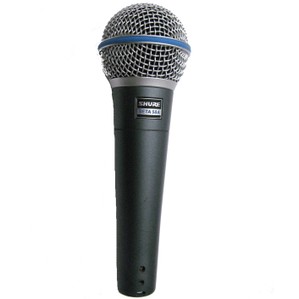
Dynamic stage mic for vocals
.jpg)
Like the Shure SM58, the Beta 58A is an awesome stage vocal mic. It has an advanced polar pickup pattern (supercardioid) and a slightly wider frequency response than the SM58.
.jpg)
After five years, this mic has never let me down. Even after being thrown to the wolves (the kind that look like drunk bar girls), it has held up just fine… though it no longer has that “new mic” smell.
.jpg)
For about $60 more than the SM58, the Beta 58A was totally worth it for me. Its features are significant enough to make a difference in the world of professional stages.

A Few Steps Up From the Mic Classic
For about $60 more than the SM58, the Beta 58A was totally worth it for me. Its features are significant enough to make a difference in the world of professional stages.
For the past five years, I’ve faithfully used and abused the Shure Beta 58A on stage. It’s delivered thousands of performances in salt air, smoky bars, and other stages closely resembling the 2nd Circle of Hell. At weddings, I can hand the mic to priests and family members with confidence, knowing the Beta 58 is worthy of holy hands and drunken bridesmaids who get all too friendly with its phallic shape.
Actually, one of the distinguishing factors between the SM58 and the Beta 58 is the frame and isolation. "The Beta has an [improved] shock mount,” according to Shure Incorporated’s Director of Applications Engineer Michael Pettersen. “If you were to slide your hand down an SM58 and a Beta 58, you'd notice less noise with the Beta." That’s good news for the bridesmaid. And that’s not the only structural difference.
"[The Beta 58] has a ball grill that is hardened. If both mics are dropped head-first onto a wooden floor, the Beta 58 grill will not dent or dent far less than the
SM58 grill,” said Pettersen.
Eventually the nature of stage performance will test the durability of your gear. It’s common for someone to trip in the labyrinth of cords on stage, taking down mic stands and the mics along with it. Dynamic mics are known for their ability to take a good ass-whooping, but the Beta 58A, believe it or not, can endure much more.
Then there are the technical component differences. “The Beta 58 has a neodymium magnet; the SM58 has an alnico magnet. The Shure Beta 58A magnet has a stronger field and thus provides a hotter output signal than the SM58,” said Pettersen.
The difference in magnetic strength is easily noticed when the two mics are placed in adjacent channels on a board. Less gain is needed to bring the Beta 58 up to working volume.
The polar pickup pattern on the Beta 58A is supercardioid, giving it wider pickup than the SM58, and the frequency response is a little larger as well, from 50Hz to 16kHz.
My decision to make the Beta 58A my permanent vocal mic was finally swayed for its proximity dynamic. I don’t like soundmen messing with my gains and volumes, so I control my own dynamics during performance by backing off or “getting friendly” with the mic (hey it’s my mic). The Shure Beta 58A accommodates this by rolling off the lower frequencies as the sound source gets further from the mic. This adds more dynamic to the pickup, especially since these vocal parts are mostly harmonies. When I want a dominant sound with lots of presence, my lips are nearly touching the grill. At this distance, there is a 10dB hump around 200Hz. As a bass/tenor range, the Beta 58 delivers the perfect tone for my voice.
My mic selection is congruous with Pettersen and Shure’s philosophy: select the mic that’s right for you, regardless of type, brand or price. The Shure Beta 58A is my toothbrush, and I feel most comfortable when it is in front of me.
Technical Info:
Type: Dynamic
Polar Pattern: Supercardioid
Frequency Response: 50Hz to 15kHz
Output Level: at 1kHz, Open Circuit Voltage: -51.5 dBV/Pa* (2.6 mV) *1 Pa = 94 dB SPL
Impedance: 150 Ohms
Price: $159.99
Be sure to check out the other Microphone Reviews
Were to Buy:
You can find this Mic on this Insturment Pro Page. It may also be available on the American Musical Supply Site

Speak Your Mind