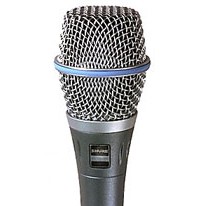
Supercardioid vocal condenser for the stage
.jpg)
Supercardioid pattern means a tight area of sound pickup, making this the perfect mic for loud stages. Hard of hearing and need those monitors cranked to 11? No problem. The Shure Beta 87A has awesome feedback rejection.
.jpg)
I’ve been using the Beta 87A for four years without any problems. Just remember, as with any condenser, it requires phantom power. And, despite what Shure says, this mic will not fully measure up to studio condensers.
.jpg)
Great for the stage but not my preference for studio work. It’s perfect for performers singing around loud instruments and monitors, or for the wandering vocalist who likes to take a walk in front of the PA.

A Sick Vocal Condenser
It’s perfect for performers singing around loud instruments and monitors, or for the wandering vocalist who likes to take a walk in front of the PA.
Stage sound engineers have a daunting challenge. Their job is to balance the equation: on one side, there is the comfort of the musicians, and on the other side is the function and limit of the equipment. This proves to be most difficult when the guitarist wants his monitor cranked to infinity, and you’re riding the fader, sweating bullets every time you hear the stock SM58 squeak feedback. I lose sleep over this scenario. Thankfully, there is a microphone in my suitcase that provides awesome feedback rejection and great isolation from nearby instruments.
The Shure Beta 87A has made it through more than 400 shows with my band. My brother chose it because he is the lead singer and drummer (a la Collins, Henley, etc.). It performs exactly how we hoped, rejecting his drum kit very well. The only drum that bleeds noticeably into the Beta 87A is the high hat, probably because the 87’s frequency curve has a +5dB bump around 9 kHz. It actually sounds good, though, since I don’t mic the hats on stage.
The reason the Beta 87A performs so well lies in its pickup pattern. It is supercardioid, and has a tight area from which it picks up sound. Further, the frequency curve provides bright tone and superb vocal presence, while rejecting the low frequencies the further away they are. The difference is drastic: at singing distance (approximately 3/8”) the response at 100 Hz is around 9+dB. At two feet away, 100 Hz drops to about –15dB. The kick drum’s thump or the toms’ lower bodies are non-existent in the Beta 87A channel. Even when his back is to a hard surface and the instruments bounce right into the front of the mic, it holds its ground by masterfully rejecting these instruments.
We use Mackie SRM350 active loudspeakers as floor monitors. The drummer’s monitor is kept at a right angle to the kit, about three feet from the Beta 87A. In line, we use Behringer Ultragraph Pro FBQ3102 dual channel graphic EQ with feedback detection. Kept flat, the channel with the Beta 87A is much less offensive to feedback than the other mics on stage.
So there you have it. This is the mic for you if you want your monitor mixes blaring or the lead singer wants to wander off stage and into the audience area. I’m not saying you can drop the mic into the tweeter and expect a dry signal, but you’re better off than trying that with an SM58… by far.
Technical Info:
Cartridge Type: Condenser (electret bias)
Frequency Response: 50 to 20,000 Hz
Polar Pattern: Supercardioid
Output Impedance: Rated at 150 ohms (100 ohms actual +/- 20%)
Recommended minimum load impedance: 800 ohms
Sensitivity (at 1,000 Hz) Open Circuit Voltage -52.5 dBV/Pa (2 mV)(1 Pa = 94 dB SPL):
Clipping Level (at 1,000 Hz): 1000 ohm Load: -6 dBV (0.5 V)
Maximum SPL (at 1,000 Hz): 140.5 dB (0.25% THD, 1000 ohm load)
Self-Noise (equivalent sound pressure level; measured with true rms voltmeter): 23.5 dB typical, A-weighted; 25.5 dB typical, weighted per DIN 45 405
Dynamic Range: 117 dB (maximum SPL to A-weighted noise level)
Signal-to-Noise Ratio: 70.5 dB at 94 dB SPL (IEC 651)
Power: Phantom Supply Requirement: 11 to 52 Vdc, positive at both pins 2 and 3
Current Drain: 1.0 to 1.2 mA
Case: Aluminum construction with blue metallic finish, and hardened steel grille with nickel satin chrome plating
Price: $462.88
Be sure to check out the other Microphone Reviews
Were to Buy:
You can find this Mic on this Insturment Pro Page. It may also be available on the American Musical Supply Site

Speak Your Mind